

April 2026 euro area bank lending survey
28 April 2026
- Banks tightened credit standards across all loan categories, driven by higher perceived risks and lower risk tolerance
- Banks expect to also tighten credit standards in the second quarter, influenced by geopolitical tensions, energy developments, and higher funding costs
- Loan demand from firms and households expected to decrease, resulting from reduced financing for fixed investments, lower consumer confidence, and decreased spending on durables
- Nearly half of euro area banks use securitisation to grant new loans, manage credit risk and enhance liquidity and funding, relying on non-bank financial entities to purchase securitised loans
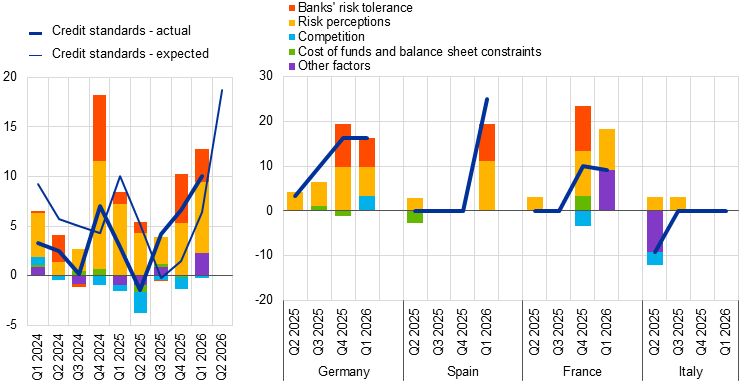
According to the April 2026 bank lending survey (BLS), euro area banks reported a further, larger than expected, net tightening of credit standards – banks’ internal guidelines or loan approval criteria – for loans or credit lines to enterprises in the first quarter of 2026 (net 10% of banks; Chart 1). Banks reported a small net tightening of credit standards for loans to households for house purchase (net 2%), whereas credit standards for consumer credit and other lending to households continued to tighten more markedly (net 15%). For firms, the net tightening was larger than expected in the previous round (6%), stood above the historical average and represented the most pronounced tightening since the third quarter of 2023, highlighting a continued cumulative tightening trend that began in mid-2025. Perceived risks to the economic outlook and lower risk tolerance of banks were the main contributing factors, with banks indicating in a dedicated open-ended question that geopolitical and energy developments exerted tightening pressure. Some banks reported additional tightening from exposures to energy-intensive firms and to the Middle East. Banks reported a small net tightening of credit standards for housing loans, while credit standards for consumer credit tightened further. For housing loans, risk perceptions had a tightening impact on credit standards, while competition had a small easing impact. Banks’ lower risk tolerance and higher risk perceptions were the main drivers of the tightening for consumer credit. For the second quarter of 2026, banks expect a widespread and more marked net tightening of credit standards for loans to firms and loans to households for house purchase and a further tightening for consumer credit.
Banks’ overall terms and conditions – the actual terms and conditions agreed in loan contracts – tightened for loans to firms and consumer credit, while they remained unchanged for housing loans.
Banks reported a net increase in the share of rejected loan applications for all borrower groups. The net increase in the share was higher for consumer credit than for firms and housing loans.
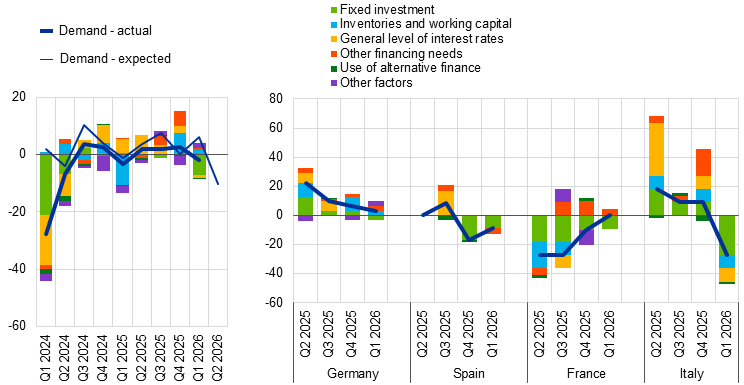
In the first quarter of 2026, euro area banks reported a slight net decrease in demand for loans or credit lines to firms (net percentage of -2%; Chart 2), in contrast to the expectations of increased demand outlined in the previous survey (6%). The net decrease was mainly driven by a decrease in demand for fixed investment, partially offset by increased demand for inventories and working capital, primarily among small and medium-sized enterprises (SMEs). In a specific open-ended question some banks highlighted that ongoing developments in energy prices were driving increased liquidity demand from firms, while others pointed to higher uncertainty and postponement of investments as factors dampening demand. Demand for housing loans was unchanged (net percentages of 0%), weaker than banks’ expectations in the previous quarter (3%). Deteriorating consumer confidence and developments in interest rates contributed negatively to housing loan demand. Demand for consumer credit and other lending to households declined strongly (net percentage of -11%), following a small decline in the previous quarter and contrasting with banks’ expectations of a minor increase (2%). Consumer credit demand declined further, reflecting weaker spending on durable goods and lower consumer confidence, as well as a negative contribution from the general level of interest rates. In the second quarter of 2026, banks expect further declines in demand for housing loans (-20%) and consumer credit (-9%).
Euro area banks’ access to debt securities, money markets and securitisations deteriorated in the first quarter of 2026, while it remained broadly unchanged for retail funding. The deterioration in access to debt securities, the most significant since the first quarter of 2023, was driven by both short-term and medium to long-term securities. Banks expect access to debt securities, retail and money market funding, and to securitisation markets to deteriorate over the next three months.
Euro area banks reported a net tightening impact of non-performing loan (NPL) ratios and other credit quality indicators on their credit standards for loans to firms and consumer credit in the first quarter of 2026, while credit standards for housing loans were broadly unaffected. Banks indicated that higher risk perceptions, lower risk tolerance, pressure stemming from supervisory or regulatory requirements and costs related to balance sheet clean-up operations contributed to the net tightening. For the second quarter of 2026, euro area banks expect a further tightening impact of credit quality on their credit standards for loans to firms and, more markedly, for consumer credit.
Banks reported a neutral impact of the ECB’s key interest rate decisions on their net interest income over the past six months, with a small negative impact on margins offsetting a small positive impact from volumes. Euro area banks expect a higher margin effect and a lower volume effect from ECB key interest rate decisions in the next two quarters, with a positive overall effect on profitability.
In response to a new question on banks’ securitisation activities and their impact on lending, nearly half of euro area banks reported using either traditional or synthetic securitisation. Synthetic significant risk transfer (SRT) is the most cited form of securitisation deemed important by euro area banks, followed by non-SRT traditional securitisation and SRT traditional securitisation. Euro area banks identified freeing up capital to issue new loans as the primary motivation for securitising loans, followed by improving banks’ liquidity position, managing credit risks, improving access to funding, meeting regulatory or supervisory requirements, following market trends and distributing capital. Private investment funds and insurance corporations and pension funds were highlighted as the most significant investors purchasing securitised loans, followed by supranational institutions, other banks, and other non-bank financial institutions. Banks reported that securitisation contributed to supporting loan volumes across all market segments over the past year, especially for loans to firms, while its contribution to easing credit standards during the same period was minimal. Looking ahead, banks anticipate an increasingly positive impact of securitisation on lending volumes across all segments in the next year, especially for loans to firms.
The quarterly BLS was developed by the Eurosystem to improve its understanding of bank lending behaviour in the euro area. The results reported in the April 2026 survey relate to changes observed in the first quarter of 2026 and changes expected in the second quarter of 2026, unless otherwise indicated. The April 2026 survey round was conducted between 19 March 2026 and 7 April 2026. A total of 161 banks were surveyed in this round, with a response rate of 100%.
Chart 1
Changes in credit standards for loans or credit lines to enterprises, and contributing factors
(net percentages of banks reporting a tightening of credit standards, and contributing factors)
Source: ECB (BLS).
Notes: Net percentages are defined as the difference between the sum of the percentages of banks responding “tightened considerably” and “tightened somewhat” and the sum of the percentages of banks responding “eased somewhat” and “eased considerably”. The net percentages for “Other factors” refer to an average of the further factors which were mentioned by banks as having contributed to changes in credit standards. Data are for the euro area and for the four largest euro area countries.
Chart 2
Changes in demand for loans or credit lines to enterprises, and contributing factors
(net percentages of banks reporting an increase in demand, and contributing factors)
Source: ECB (BLS).
Notes: Net percentages for the questions on demand for loans are defined as the difference between the sum of the percentages of banks responding “increased considerably” and “increased somewhat” and the sum of the percentages of banks responding “decreased somewhat” and “decreased considerably”. The net percentages for “Other factors” refer to an average of the further factors which were mentioned by banks as having contributed to changes in loan demand. Data are for the euro area and for the four largest euro area countries.
For media queries, please contact Benoit Deeg, tel.: +49 (0) 69 134495686.
Notes
Legal Disclaimer:
EIN Presswire provides this news content "as is" without warranty of any kind. We do not accept any responsibility or liability for the accuracy, content, images, videos, licenses, completeness, legality, or reliability of the information contained in this article. If you have any complaints or copyright issues related to this article, kindly contact the author above.
